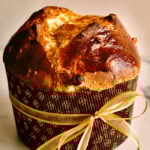
Traditional Italian Panettone
This traditional Italian panettone is a sweet and tender orange-scented sweet bread studded with candied fruits and raisins. You will want to devour this buttery bread at every Christmas celebration!
Servings: 12 servings
Ingredients
For the Starter Dough/Biga
- ¾ cup unbleached all-purpose flour
- 1 pinch instant yeast
- ⅓ cup cool water
Mix-Ins
- ½ tablespoon lemon zest from 1 lemon
- 1 tablespoon orange zest from 1 orange
- 2 tablespoon honey
- 2 teaspoons vanilla extract
- ½ cup raisins
- 3 tablespoons water
For the Dough
- all of the starter dough from above
- 3 cups all-purpose flour divided
- ½ cup lukewarm water
- 1 tablespoon instant yeast
- ⅓ cup granulated sugar
- 1¼ teaspoon salt
- 5 egg yolks room temperature
- 8 tablespoons butter softened
- ½ cup candied orange peel, finely chopped
For the Topping
- 1 beaten egg
- 1 pat butter for topping
- pearl sugar optional
Instructions
The Night Before Baking
- Starter Dough/Biga: Combine the starter ingredients in a medium-sized mixing bowl, mix with a fork until a shaggy mixture. Cover, and allow it to rest in a warm place for 8-12 hours. This is a biga, a type of pre-fermentation. (You can use a sourdough starter instead of the biga; simply use 190g of proofed starter and move on to step 1 of baking day.)
- Mix-Ins: In a small bowl, combine the honey, vanilla extract, orange peel, and lemon + orange zest. Mix to combine. Cover and set aside. In a separate bowl, combine raisins with water. Cover and set aside. This step makes sure the raisins stay moist during baking. Let them rest overnight.
On the Baking Day
- Dough Part 1 and First Rise: Combine the dough starter (biga), half of the flour, and all of the water and yeast in a stand mixer with a dough hook. Mix until combined, and knead with the dough hook (or by hand) for about 5 minutes. Cover with plastic wrap and let rise for 1 hour in a warm place. The dough should triple in size.
- Dough Part 2: After the dough rises for 1 hour, add the rest of the flour and mix to combine. The dough will look shaggy and crumbly. Let rest for 10 minutes.
- Meanwhile, beat the egg yolks, salt, and sugar in a medium bowl until fluffy and creamy, about 5 minutes. Add the honey, candied orange, and zest mixture to the beaten eggs and stir until combined.
- Slowly add the egg and orange mixture to the dough. Mix with a dough hook until the dough is sticky and uniform; mix with a dough hook (or by hand) for about 5 minutes. The dough will be sticky, and it will take several minutes to come together, about 10 minutes of kneading!
- Add the butter to the dough, small bits at a time, mixing after each addition. Mix dough with a dough hook (or by hand) until a smooth dough forms (still sticky). After the butter is incorporated, add the raisins (remove excess water, if any). Gently mix until the raisins are incorporated into the dough. Make the dough into a ball. Move the dough to a clean and greased bowl.
- Second Rise: Cover the dough, and let it rise for 1 to 2 hours, or until it's doubled in size. Gently deflate the dough.
- Fold Dough: Move to a greased baking sheet or countertop and lightly grease your hands. Working clockwise, pinch the top corner of the dough (12 o'clock position), lift it up and let the dough stretch, then fold the dough back on itself (6 o'clock position). Turn the dough 90 degrees clockwise (the 12 o'clock position is now the 3 o'clock position). Repeat this process of stretching and folding two more times.
- Let the dough rest for 10-15 minutes, then repeat the full folding process two more times with a rest between each.
- Shape Dough: Bring the corners in toward the center to form a ball, and pinch the loose ends together. Cup your hands around the dough to round the ball. Place it in a well-buttered or sprayed panettone pan, mold paper, or other straight-sided, tall 1½ to 2-quart pan.
- Dough Rise 3: Let the dough rise in a warm place until it reaches over the rim of the mold, about 1½-2 hours (time varies depending on humidity and temperature).
- Topping: When the rise is complete, brush the top with egg wash. Make cross cuts on the panettone with a sharp knife, and put a small pat of butter in the center of the cake. Sprinkle with pearl sugar (optional).
- Bake: Bake in a preheated 375°F oven for 10 minutes; then reduce the heat to 350°F and bake for about 30-35 minutes, tenting with aluminum foil if the top of the panettone appears to be browning too fast.
- When finished baking, the panettone should be a deep brown, sound hollow when tapped, and read 190°F at the center using a digital thermometer. (It's easy to underbake panettone since the top can brown quickly, so be sure to check with a thermometer.)
- Cool & Rest: To cool the panettone, pierce each side with a bamboo skewer, flip it over, and hang it between two tall jars. Hanging it upside down for a few hours prevents the panettone from caving in on itself. You do not have to cool it upside down; you can cool it on a cooling rack.
- Serve: Slice in wedges and enjoy. Store at room temperature, well-wrapped, for up to a week; freeze for longer storage.
Notes
- This recipe makes 2 small panettone or 1 large one. The small molds I use measure 5¼" x 3¾" and hold a 500g loaf. The large mold I use measures 6⅝" x 4⅓" and holds a 1kg loaf. This is the size I used.
- Use room temperature ingredients and measure them with a kitchen scale for accuracy.
- Hydrate the raisins in a bit of water, or they will be dry.
- Make sure your yeast is NOT expired, or you will do a lot of work for nothing.
- Follow the recipe exactly and be patient with the dough rising at the different stages. Find the warmest place in your home, or use a proofing oven.
Nutrition
Serving: 1slice | Calories: 315kcal | Carbohydrates: 49g | Protein: 6g | Fat: 11g | Saturated Fat: 6g | Polyunsaturated Fat: 1g | Monounsaturated Fat: 3g | Trans Fat: 0.3g | Cholesterol: 116mg | Sodium: 323mg | Potassium: 119mg | Fiber: 2g | Sugar: 14g | Vitamin A: 376IU | Vitamin C: 1mg | Calcium: 24mg | Iron: 2mg
